Managed IT support Swindon: Businesses depend on services, and in 2026, it’s critical to security, productivity, and resilience.
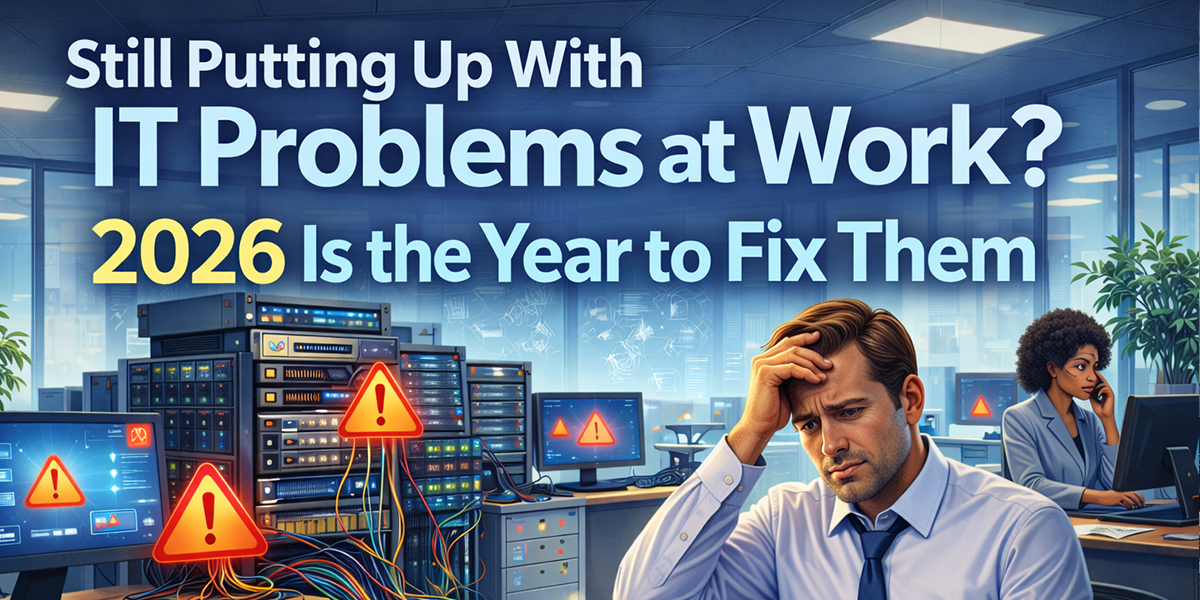
For many UK businesses, the start of a new year brings a familiar routine. Teams return after the Christmas break, projects restart, and the same frustrations quietly reappear — especially when it comes to IT.
Slow systems. Password problems. Software that behaves unpredictably. Support tickets that take days to resolve. Security warnings that are mentioned but never fully explained.
If this sounds familiar, you’re far from alone.
Across Swindon and the wider UK, many organisations tolerate IT issues for years. Not because they don’t matter — but because dealing with them feels disruptive, risky, or simply like something to “get round to later”.
As we move into 2026, more businesses are realising that approach no longer works.
This article looks at the IT problems businesses quietly put up with, why they persist, and why now is the right time to address them — particularly when security and compliance are no longer optional.
The everyday IT problems businesses learn to live with
Most businesses don’t experience one dramatic IT failure. Instead, it’s the accumulation of small, ongoing issues that slowly erode productivity and confidence.
Common examples include:
Slow or inconsistent response times from IT support
Repeated “temporary fixes” to the same problems
Staff unsure who to contact when something goes wrong
Unclear explanations of what’s been done or why
Systems that feel fragile rather than reliable
Security concerns that are acknowledged but never resolved
Over time, teams stop reporting issues because they assume nothing will change. That’s usually when IT support stops being a help and becomes a background frustration.
Why these problems rarely get fixed
If these issues are so common, why don’t more businesses act sooner?
1. Familiarity feels safer than change
Even when support is slow or unhelpful, many organisations stick with their existing provider because it feels less risky than switching.
2. Fear of disruption
There’s often concern that reviewing or changing IT support will cause downtime, data loss, or confusion for staff.
3. A lack of clear benchmarks
If you’re not technical, it can be difficult to know whether your IT support is genuinely underperforming or simply “normal”.
4. Contracts that quietly roll over
Before you realise it, another year has passed — and the same issues remain.
Why 2026 is different
The role of IT has changed permanently.
In 2026, IT underpins almost every part of a business:
Hybrid and remote working
Client communication
Data protection and compliance
Business continuity
Cybersecurity
At the same time, cyber threats are increasing, regulations are tightening, and insurers are demanding higher security standards.
What was once considered “good enough” IT is now a liability.
The security issue many businesses underestimate
One of the biggest changes in recent years is how security expectations have shifted.
Many businesses assume cybersecurity only matters to large enterprises. In reality, small and medium-sized organisations are now the most common targets.
Common warning signs include:
No clear password policy
Devices not regularly updated
Staff unsure how to spot phishing emails
No formal security baseline
Assumptions that “we’re too small to be targeted”
This is where standards like Cyber Essentials come in.
Why Cyber Essentials is becoming the minimum standard
Cyber Essentials isn’t about enterprise-level complexity. It’s about ensuring basic, sensible security controls are in place.
It focuses on fundamentals such as:
Secure configuration
Access control
Malware protection
Patch management
Firewall and boundary security
For many organisations, achieving Cyber Essentials doesn’t require a complete overhaul — just structure, consistency, and accountability.
More importantly, it provides:
A recognised security baseline
Reduced risk of common cyber attacks
Increased confidence when working with clients and partners
Alignment with modern insurance and compliance expectations
In 2026, operating below this level increasingly exposes businesses to unnecessary risk.
What good IT support looks like in 2026
Modern IT support should feel calm, predictable, and proactive — not reactive and chaotic.
Businesses should reasonably expect:
Clear, plain-English communication
You should understand what’s happening and why, without technical jargon.
Proactive maintenance
Issues should be prevented wherever possible, not simply reacted to.
Security as standard, not an add-on
Basic security hygiene should be built in — not sold separately after an incident.
Predictable costs
IT should be easy to budget for, not a source of surprise invoices.
Accountability
You should know who is responsible, what response times apply, and where to turn when something isn’t right.
The value of local managed IT support
For many organisations, working with a local IT support provider offers clear advantages:
Faster response when on-site support is required
Better understanding of local business needs
Long-term relationships rather than ticket numbers
Clear accountability
For businesses in and around Swindon, having accessible, dependable IT support can make a tangible difference — particularly when security, compliance, and continuity are at stake.
Signs it’s time to review your IT support
Ask yourself:
Are IT issues disrupting work more than they should?
Do problems repeat instead of being permanently resolved?
Are you confident your security meets modern expectations?
Could you clearly explain your IT setup to an insurer or auditor?
Do you feel supported — or simply tolerated?
If several of these raise doubts, a review is overdue.
Importantly, reviewing your IT doesn’t mean committing to change. Often, it simply provides clarity and highlights practical improvements.
Starting 2026 without the same frustrations
Another year of tolerating avoidable IT issues helps no one.
For many businesses, addressing long-standing problems leads to:
Fewer interruptions
Improved staff confidence
Stronger security posture
Greater peace of mind
Good IT support shouldn’t be something you notice — it should quietly enable your business to operate securely and efficiently.
About Sysflex
Sysflex provides managed IT support for businesses in Swindon and across the UK. Our approach focuses on proactive support, clear communication, and ensuring every client meets a sensible security baseline — including Cyber Essentials.
If you’re unsure whether your current IT setup is fit for 2026, a straightforward review can often identify practical improvements without disruption.

James Zalewski – CEO / Owner – Sysflex Ltd
E-Mail: james@sysflex.co.uk
Telephone: 0330 321 6284